Buy inning.eu ?
We are moving the project
inning.eu .
Are you interested in purchasing the domain
inning.eu ?
domain@kv-gmbh.de · 0541-91531010
Buy inning.eu ?
What happened during the Franco-Prussian War from 1870 to 1871?
The Franco-Prussian War was a conflict between the Second French Empire and the Kingdom of Prussia, along with its allies from the North German Confederation. The war was sparked by tensions over the Spanish throne and resulted in a swift Prussian victory. The French suffered a series of defeats, including the decisive Battle of Sedan, which led to the capture of Emperor Napoleon III. The war ended with the Treaty of Frankfurt, in which France ceded the territories of Alsace and Lorraine to the newly formed German Empire. This war also marked the end of the Second French Empire and the establishment of the Third French Republic. **
Can someone explain the cartoon about the Franco-Prussian War to me, and the one image with Otto von Bismarck and Napoleon?
The cartoon about the Franco-Prussian War likely depicts Otto von Bismarck, the Chancellor of Prussia, manipulating the situation to provoke a conflict with France in order to unite the German states under Prussian leadership. The image with Bismarck and Napoleon may show Bismarck outmaneuvering Napoleon III of France, leading to the defeat of the French forces and the eventual unification of Germany under Prussian dominance. Bismarck's cunning diplomacy and military strategy played a crucial role in the outcome of the war and the establishment of the German Empire in 1871. **


Similar search terms for Franco-Prussian
Top-Angebote
Products related to Franco-Prussian:
-
Terpin Franco Ribolla Gialla Franco Terpin 2020The Ribolla Gialla by Franco Terpin is a white wine produced artisanally in Friuli Venezia Giulia, in the magnificent hilly area of San Floriano al Collio, not far from the Slovenian border. It is a wine of great character and territorial identity, marked by the characteristics saline and mineral qualities of the flysch or ponca soils. The mild, breezy, and sunny climate of Collio allows for perfect ripening of the grapes. The long aging in wood gives an intense, complex, and evolved white that, alongside the fresh varietal aromas of Ribolla Gialla, combines tertiary notes of great elegance and a deep, persistent sip. The Ribolla Gialla wine comes from a family-run winery that owns about ten hectares in the Collio Goriziano. Only in the 1990s did Franco Terpin decide to start vinifying and bottling the grapes, which were previously sold to other producers in the area. The vineyards are located on Monte Calvario and are cultivated on prized limestone and sandstone marls, rich in mineral substances. These lands are particularly suitable for quality viticulture, focused on low yields. In the countryside, the use of herbicides or synthetic chemicals is absolutely banned, and the few treatments are done only with sulfur and copper. In the winery, long aging processes are employed to allow the wines to express their full aromatic potential without haste.absolutely banned the use of herbicides or synthetic chemicals, and the few treatments are done only with sulfur and copper. In the winery, long aging processes are employed to allow the wines to express their full aromatic potential without haste. The Ribolla Gialla white from the Friulian winery of Franco Terpin is produced with the best bunches from vines aged between 8 and 20 years, cultivated with a south-southwest exposure. After soft pressing, fermentation takes place in steel tanks and oak barrels, occurring spontaneously with indigenous yeasts. The wine ages for 12 months in barrique, 12 months in steel, and 12 months in bottle, and is marketed without filtration. In the glass, it presents an intense golden yellow color. On the nose, it releases a complex bouquet, with aromas of yellow fruit, dehydrated apricot, chestnut honey, aromatic herbs, and iodized hints. The sip is long and complex, with dense and rich aromas that anticipate a harmonious, fresh, and saline finish. A Ribolla Gialla that perfectly expresses the character and personality of the land of Collio.35,00 £*Shipping: 48,00 £Secure redirect to the provider
-
Terpin Franco Quinto Quarto Bianco Franco TerpinThe Quinto Quarto is a Friulian orange wine born from the mind of Franco Terpin; a boundary winemaker who started producing wine in 1994 in San Floriano del Collio, not far from Slovenia, with the aim of honoring this area through the creation of "macerated" wines that combine personality and pleasantness. Just like this Quinto Quarto Bianco, which comes from a skillful blend of white grapes and reveals its connection to the territory thanks to an exquisitely mineral texture. The Franco Terpin winery produces this Quinto Quarto Bianco from a blend where white grapes come together gracefully. The grapes grow in vineyards where synthetic chemical products are not used, and where only low doses of sulfur and copper are allowed to counteract the development of bacteria; after the harvest, which is strictly done by hand, the must is spontaneously fermented in steel thanks to the use of indigenous yeasts, macerating in contact with the skins for three days. After aging, at the time of bottling, the resulting wine is not clarified nor filtered. The Quinto Quarto is a white wine that in the glass manifests with an intense straw yellow color, characterized by slight golden hues. The olfactory spectrum highlights fresh and varied notes, where, alongside citrus sensations, more floral and mineral aromas are proposed. On the palate, it is smooth-bodied, with a lively and fresh sip, relying on a clearly savory personality; it ends with a finish characterized by a slightly spicy aftertaste. A label where character and style are found in a sip that Franco Terpin interprets in a traditional and authentic way, dedicated to all those who want to try their hand at an orange wine.18,00 £*Shipping: 48,00 £Secure redirect to the provider
-
Terpin Franco Pinot Grigio 'Sialis' Franco Terpin 2018The Pinot Grigio "Sialis" belongs to the line of white wines produced by Franco Terpin. It is obtained from selected grapes of Pinot Grigio from the historic cru Sialis, located on the high hill of San Floriano al Collio. The Pinot Grigio "Sialis" is produced only in particular vintages with a careful selection of bunches and very low yields. The Sialis subzone is located on the southern slopes of Mount Calvario and includes about 3 hectares of vineyards. The vineyards are historic, over 70 years old, and are surrounded by the Friulian woods. The microclimate that has naturally developed favors a perfect environment for grape cultivation. In fact, the soil is clayey and calcareous, from which the wine derives pleasant mineral notes. The strong temperature excursions and the light breeze that blows constantly on the hill contribute to creating a unique and expressive wine. The nature surrounding the rows has not seen chemical products for over 30 years and is left to grow undisturbed. The Pinot Grigio "Sialis" is obtained from a fermentationnatural with indigenous yeasts, in absence of filtration and stabilization and with a long contact with the skins. The wine rests in wood for a few months, enriching itself with sweet and soft notes. It has an intense coppery pink color with bright reflections. The bouquet is deep and complex: hints of fruit jam follow sweet and aromatic spicy tones of vanilla, ginger, and mint. It has a small residual sugar that balances an intoxicating freshness. On the palate, it is harmonious: it has elegance and structure to sell and a very long finish.37,00 £*Shipping: 48,00 £Secure redirect to the provider
-
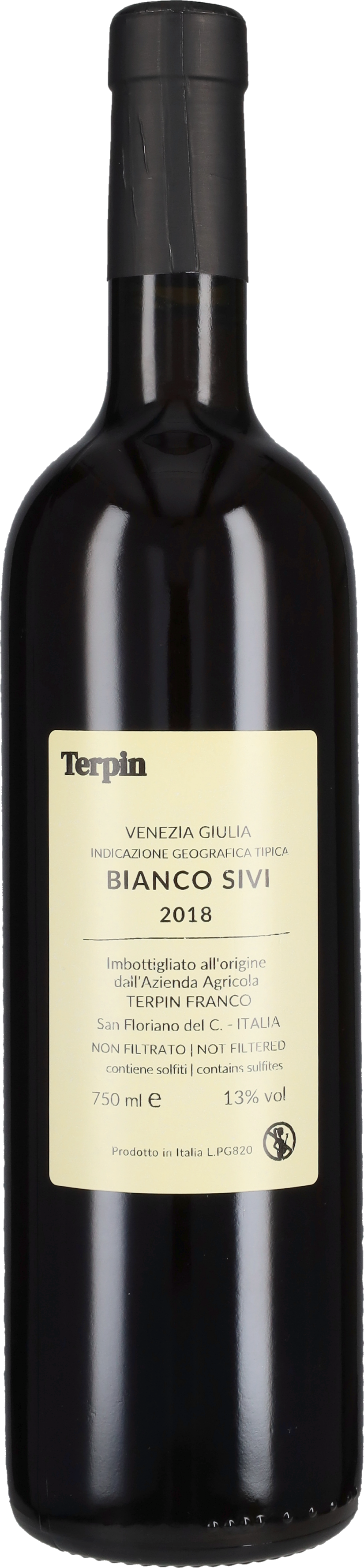
Terpin Franco Bianco Sivi 'Quinto Quarto' Franco Terpin 2023The Bianco Sivi Quinto Quarto encapsulates all the character of Pinot Grigio, generous yet layered. Franco Terpin's new line has the merit of telling each grape variety at his disposal individually, with interpretations that are immediately enjoyable and surprising in their quality-price ratio. The belief that unites all of Franco's "creatures" is the result of work that has involved years of experimentation and attempts, with a fervor and curiosity that persist to this day. In the vineyard, as always, no chemical substances or herbicides are used, only a bit of copper and sulfur. Perfectly healthy grapes and spontaneous fermentations, with long macerations on the skins, both for whites and reds. Among the most personal stories of the Collio wine region, now become a must for enthusiasts and the curious. The Sivi white wine is obtained from pure Pinot Grigio grapes, hand-picked and selected from the Stamas vineyard located on Monte Calvario at 100-150 meters above sea level on clayey-marls soils, locally called Ponca. If in the vineyard, as already mentioned, no chemical shortcuts are taken, in the winery the same firmness continues: spontaneous alcoholic fermentations and, in the case of Pinot Grigio, a shorter maceration on the skins, given the generosity of the grape's skin.it does not resort to any chemical shortcuts, in the winery it continues with equal firmness: spontaneous alcoholic fermentations and, in the case of Pinot Grigio, a shorter maceration on the skins, given the generosity of the grape's skin. Aging of the liquid for several months in steel containers. The Sivi Bianco by Terpin has the typical appearance of Pinot Grigio, enchanting in its shift towards amber. A pulsating liquid that does not hide its complexity from the first sniff, made up of citrus peel, acacia honey, wild herbs, and balsamic hints. The tasting is no less, as the liquid, thanks to a filling matter, takes possession of the palate almost gracefully. Thanks to its saltiness and freshness, certainly, as well as an excellent hand in the winemaking phase. A wine of authorship, it must be said!20,00 £*Shipping: 48,00 £Secure redirect to the provider



-
Can someone explain the cartoon about the Franco-Prussian War to me and the one image with Otto von Bismarck and Napoleon?
The cartoon about the Franco-Prussian War likely depicts Otto von Bismarck, the Chancellor of Prussia, outwitting Napoleon III of France. Bismarck's cunning diplomacy and military strategy played a crucial role in Prussia's victory over France in the war, leading to the unification of Germany in 1871. The image with Bismarck and Napoleon may symbolize the power dynamics and political maneuvering that took place during the conflict, showcasing Bismarck's skill in manipulating the situation to achieve his goals. **
-
Can someone explain the cartoon about the Franco-Prussian War and the one image with Otto von Bismarck and Napoleon to me?
The cartoon about the Franco-Prussian War likely depicts Otto von Bismarck, the Chancellor of Prussia, outmaneuvering Napoleon III of France. Bismarck's cunning diplomacy and military strategy ultimately led to the defeat of the French forces and the unification of Germany under Prussian leadership. The image with Bismarck and Napoleon may symbolize the power dynamics and the eventual triumph of Prussia over France in the war, showcasing Bismarck's skillful political maneuvering. **
-
What are the reasons for the outrage of many French people over the peace conditions of the Franco-Prussian War of 1871?
Many French people were outraged over the peace conditions of the Franco-Prussian War of 1871 for several reasons. Firstly, the loss of the territories of Alsace and Lorraine to Germany was a source of national humiliation and resentment. Secondly, the heavy war indemnity imposed on France by Germany placed a significant financial burden on the country. Additionally, the presence of German troops in France until the war indemnity was paid further fueled the anger and sense of occupation among the French population. These conditions contributed to a deep sense of injustice and a desire for revenge among many French people. **
-
Am I Prussian?
Without more information about your background and ancestry, it is difficult to definitively say whether you are Prussian. Prussia was a historical state in what is now Germany, Poland, Russia, and Lithuania. If you have ancestors from this region or can trace your heritage back to Prussian roots, then you may have Prussian heritage. However, Prussia no longer exists as a political entity, so being Prussian today would be more about cultural or historical connection rather than nationality. **


What is Prussian riding?
Prussian riding, also known as classical dressage, is a style of horseback riding that originated in Prussia (now part of Germany) in the 18th century. It emphasizes harmony and communication between the rider and the horse, focusing on precise movements and balance. Prussian riding is characterized by its emphasis on lightness, flexibility, and collection, as well as the development of the horse's natural movements and abilities. It is considered a highly disciplined and elegant form of riding, and is often practiced as a competitive sport and as a form of artistic expression. **
Why was Catalan banned under Franco?
Catalan was banned under Franco's regime because he sought to suppress regional identities and promote a unified Spanish identity. Franco believed that allowing regional languages like Catalan to be spoken and taught in schools would undermine his efforts to centralize power and control over the country. By banning Catalan, Franco aimed to assert his authority and enforce a homogenous Spanish culture across the country. **
Top-Angebote
Products related to Franco-Prussian:
-
Terpin Franco Jakot Franco Terpin 2019The Jakot by Franco Terpin is an orange wine multifaceted and three-dimensional, produced by one of the bastions of the Collio wine region. The name of Franco Terpin holds significant value for all enthusiasts of artisanal wine, as one cannot help but be struck by the tasting of his liquids that are so fleshy and full of life. 10 hectares of vineyard in San Floriano del Collio, a stronghold close to Slovenia, where Franco, after a long path of experimentation, decided to create expressions that reflect the vintage and territory without any filter or constraint. The result is bottles that speak and tell stories, and which are hard to forget. Unique pieces. The white Jakot is obtained from pure Friulano grapes, a typical local variety, with vines over 60 years old that rest on Ponka, a typical local soil made up of marls and marine sediments. In the vineyard, the use of any chemical or synthetic substances is banned, and in the winery, fermentation proceeds firmly with spontaneous fermentation in steel and maceration on the skins for about 10-14days. The aging process lasts about 18 months in large oak barrels. No clarification or filtration before bottling. The wine Jakot lights up the glass with its amber hue of great intensity. It reveals itself immediately in all its generosity, with aromas of ripe apricot, honey, oriental spices, and dried fruit. A serene and indulgent profile that invites tasting. On the palate, it is symphonic, with all elements dancing in unison in a rhythmic alternation of freshness and substance. It leaves a long legacy, for a bottle that can unite novices and more experienced tasters. A universal experience.30,00 £*Shipping: 48,00 £Secure redirect to the provider
-
Terpin Franco Sauvignon Franco Terpin 2020The Sauvignon by Franco Terpin is one of the most exciting macerated whites from Collio, a liquid that blends aromaticity and compactness in a sip with kilometer-long persistence. Franco Terpin is undoubtedly one of the faces that have contributed to the enhancement of Collio, a region that has enjoyed alternating fame but thanks to figures like Josko Gravner, Stanko Radikon, Dario Princic, and indeed Franco, has managed to achieve a credibility and a territorial identity that is almost unique. In nearly 30 years of history, Franco, while not allowing himself to be overwhelmed by immobility and thus continuing to explore all the potential of local grape varieties, has pursued a non-interventionist approach, excluding the use of chemical substances in the vineyard and in the cellar. His wines have the power to combine spontaneity and finesse, and the maceration practiced on all liquids is never overpowering but serves to enhance complexity and variety of nuances. Undoubtedly among the most evocative producers in Italy. The white Sauvignon is obtained from pure grapes of the same name,vineyard, coming from 25-year-old vines that rest on the typical soils of Collio made up of Ponka, that is, sandstone marls that characterize the area. In the vineyard, as already mentioned, the principles of organic farming are followed, using only a little copper and sulfur. In the winery, spontaneous alcoholic fermentation continues and 10 days of skin maceration, without the liquid undergoing clarifications or filtrations. Aging for one year in oak barrels and one year in steel tanks before bottling. The Sauvignon wine presents itself in the glass with an intriguing amber and luminous appearance. A rich and even exotic nose, where hints of mango, dehydrated apricot, ginger, and oriental spices are outlined. The sumptuous olfactory profile corresponds to a complex and filling sip, but never baroque, energetic and rhythmic. The salty finish is decisive, also functional in amplifying the wine's persistence. A bottle that leaves an impression.32,00 £*Shipping: 48,00 £Secure redirect to the provider
-
Terpin Franco Ribolla Gialla Franco Terpin 2020The Ribolla Gialla by Franco Terpin is a white wine produced artisanally in Friuli Venezia Giulia, in the magnificent hilly area of San Floriano al Collio, not far from the Slovenian border. It is a wine of great character and territorial identity, marked by the characteristics saline and mineral qualities of the flysch or ponca soils. The mild, breezy, and sunny climate of Collio allows for perfect ripening of the grapes. The long aging in wood gives an intense, complex, and evolved white that, alongside the fresh varietal aromas of Ribolla Gialla, combines tertiary notes of great elegance and a deep, persistent sip. The Ribolla Gialla wine comes from a family-run winery that owns about ten hectares in the Collio Goriziano. Only in the 1990s did Franco Terpin decide to start vinifying and bottling the grapes, which were previously sold to other producers in the area. The vineyards are located on Monte Calvario and are cultivated on prized limestone and sandstone marls, rich in mineral substances. These lands are particularly suitable for quality viticulture, focused on low yields. In the countryside, the use of herbicides or synthetic chemicals is absolutely banned, and the few treatments are done only with sulfur and copper. In the winery, long aging processes are employed to allow the wines to express their full aromatic potential without haste.absolutely banned the use of herbicides or synthetic chemicals, and the few treatments are done only with sulfur and copper. In the winery, long aging processes are employed to allow the wines to express their full aromatic potential without haste. The Ribolla Gialla white from the Friulian winery of Franco Terpin is produced with the best bunches from vines aged between 8 and 20 years, cultivated with a south-southwest exposure. After soft pressing, fermentation takes place in steel tanks and oak barrels, occurring spontaneously with indigenous yeasts. The wine ages for 12 months in barrique, 12 months in steel, and 12 months in bottle, and is marketed without filtration. In the glass, it presents an intense golden yellow color. On the nose, it releases a complex bouquet, with aromas of yellow fruit, dehydrated apricot, chestnut honey, aromatic herbs, and iodized hints. The sip is long and complex, with dense and rich aromas that anticipate a harmonious, fresh, and saline finish. A Ribolla Gialla that perfectly expresses the character and personality of the land of Collio.35,00 £*Shipping: 48,00 £Secure redirect to the provider
-
Terpin Franco Quinto Quarto Bianco Franco TerpinThe Quinto Quarto is a Friulian orange wine born from the mind of Franco Terpin; a boundary winemaker who started producing wine in 1994 in San Floriano del Collio, not far from Slovenia, with the aim of honoring this area through the creation of "macerated" wines that combine personality and pleasantness. Just like this Quinto Quarto Bianco, which comes from a skillful blend of white grapes and reveals its connection to the territory thanks to an exquisitely mineral texture. The Franco Terpin winery produces this Quinto Quarto Bianco from a blend where white grapes come together gracefully. The grapes grow in vineyards where synthetic chemical products are not used, and where only low doses of sulfur and copper are allowed to counteract the development of bacteria; after the harvest, which is strictly done by hand, the must is spontaneously fermented in steel thanks to the use of indigenous yeasts, macerating in contact with the skins for three days. After aging, at the time of bottling, the resulting wine is not clarified nor filtered. The Quinto Quarto is a white wine that in the glass manifests with an intense straw yellow color, characterized by slight golden hues. The olfactory spectrum highlights fresh and varied notes, where, alongside citrus sensations, more floral and mineral aromas are proposed. On the palate, it is smooth-bodied, with a lively and fresh sip, relying on a clearly savory personality; it ends with a finish characterized by a slightly spicy aftertaste. A label where character and style are found in a sip that Franco Terpin interprets in a traditional and authentic way, dedicated to all those who want to try their hand at an orange wine.18,00 £*Shipping: 48,00 £Secure redirect to the provider
-
What happened during the Franco-Prussian War from 1870 to 1871?
The Franco-Prussian War was a conflict between the Second French Empire and the Kingdom of Prussia, along with its allies from the North German Confederation. The war was sparked by tensions over the Spanish throne and resulted in a swift Prussian victory. The French suffered a series of defeats, including the decisive Battle of Sedan, which led to the capture of Emperor Napoleon III. The war ended with the Treaty of Frankfurt, in which France ceded the territories of Alsace and Lorraine to the newly formed German Empire. This war also marked the end of the Second French Empire and the establishment of the Third French Republic. **
-
Can someone explain the cartoon about the Franco-Prussian War to me, and the one image with Otto von Bismarck and Napoleon?
The cartoon about the Franco-Prussian War likely depicts Otto von Bismarck, the Chancellor of Prussia, manipulating the situation to provoke a conflict with France in order to unite the German states under Prussian leadership. The image with Bismarck and Napoleon may show Bismarck outmaneuvering Napoleon III of France, leading to the defeat of the French forces and the eventual unification of Germany under Prussian dominance. Bismarck's cunning diplomacy and military strategy played a crucial role in the outcome of the war and the establishment of the German Empire in 1871. **
-
Can someone explain the cartoon about the Franco-Prussian War to me and the one image with Otto von Bismarck and Napoleon?
The cartoon about the Franco-Prussian War likely depicts Otto von Bismarck, the Chancellor of Prussia, outwitting Napoleon III of France. Bismarck's cunning diplomacy and military strategy played a crucial role in Prussia's victory over France in the war, leading to the unification of Germany in 1871. The image with Bismarck and Napoleon may symbolize the power dynamics and political maneuvering that took place during the conflict, showcasing Bismarck's skill in manipulating the situation to achieve his goals. **
-
Can someone explain the cartoon about the Franco-Prussian War and the one image with Otto von Bismarck and Napoleon to me?
The cartoon about the Franco-Prussian War likely depicts Otto von Bismarck, the Chancellor of Prussia, outmaneuvering Napoleon III of France. Bismarck's cunning diplomacy and military strategy ultimately led to the defeat of the French forces and the unification of Germany under Prussian leadership. The image with Bismarck and Napoleon may symbolize the power dynamics and the eventual triumph of Prussia over France in the war, showcasing Bismarck's skillful political maneuvering. **
Similar search terms for Franco-Prussian
-
Terpin Franco Pinot Grigio 'Sialis' Franco Terpin 2018The Pinot Grigio "Sialis" belongs to the line of white wines produced by Franco Terpin. It is obtained from selected grapes of Pinot Grigio from the historic cru Sialis, located on the high hill of San Floriano al Collio. The Pinot Grigio "Sialis" is produced only in particular vintages with a careful selection of bunches and very low yields. The Sialis subzone is located on the southern slopes of Mount Calvario and includes about 3 hectares of vineyards. The vineyards are historic, over 70 years old, and are surrounded by the Friulian woods. The microclimate that has naturally developed favors a perfect environment for grape cultivation. In fact, the soil is clayey and calcareous, from which the wine derives pleasant mineral notes. The strong temperature excursions and the light breeze that blows constantly on the hill contribute to creating a unique and expressive wine. The nature surrounding the rows has not seen chemical products for over 30 years and is left to grow undisturbed. The Pinot Grigio "Sialis" is obtained from a fermentationnatural with indigenous yeasts, in absence of filtration and stabilization and with a long contact with the skins. The wine rests in wood for a few months, enriching itself with sweet and soft notes. It has an intense coppery pink color with bright reflections. The bouquet is deep and complex: hints of fruit jam follow sweet and aromatic spicy tones of vanilla, ginger, and mint. It has a small residual sugar that balances an intoxicating freshness. On the palate, it is harmonious: it has elegance and structure to sell and a very long finish.37,00 £*Shipping: 48,00 £Secure redirect to the provider
-
Terpin Franco Bianco Sivi 'Quinto Quarto' Franco Terpin 2023The Bianco Sivi Quinto Quarto encapsulates all the character of Pinot Grigio, generous yet layered. Franco Terpin's new line has the merit of telling each grape variety at his disposal individually, with interpretations that are immediately enjoyable and surprising in their quality-price ratio. The belief that unites all of Franco's "creatures" is the result of work that has involved years of experimentation and attempts, with a fervor and curiosity that persist to this day. In the vineyard, as always, no chemical substances or herbicides are used, only a bit of copper and sulfur. Perfectly healthy grapes and spontaneous fermentations, with long macerations on the skins, both for whites and reds. Among the most personal stories of the Collio wine region, now become a must for enthusiasts and the curious. The Sivi white wine is obtained from pure Pinot Grigio grapes, hand-picked and selected from the Stamas vineyard located on Monte Calvario at 100-150 meters above sea level on clayey-marls soils, locally called Ponca. If in the vineyard, as already mentioned, no chemical shortcuts are taken, in the winery the same firmness continues: spontaneous alcoholic fermentations and, in the case of Pinot Grigio, a shorter maceration on the skins, given the generosity of the grape's skin.it does not resort to any chemical shortcuts, in the winery it continues with equal firmness: spontaneous alcoholic fermentations and, in the case of Pinot Grigio, a shorter maceration on the skins, given the generosity of the grape's skin. Aging of the liquid for several months in steel containers. The Sivi Bianco by Terpin has the typical appearance of Pinot Grigio, enchanting in its shift towards amber. A pulsating liquid that does not hide its complexity from the first sniff, made up of citrus peel, acacia honey, wild herbs, and balsamic hints. The tasting is no less, as the liquid, thanks to a filling matter, takes possession of the palate almost gracefully. Thanks to its saltiness and freshness, certainly, as well as an excellent hand in the winemaking phase. A wine of authorship, it must be said!20,00 £*Shipping: 48,00 £Secure redirect to the provider
-
Franco' Tenuta Lenzini 2024The ‘Franco’ from Tenuta Lenzini is one of the latest arrivals at Tenuta Lenzini: a Cabernet Franc that aims to pay homage to the founder of the winery: Franco, Benedetta's grandfather, who is now leading the estate together with her husband Michele. A red with a Tuscan soul produced in Gragnano, in the heart of the Lucchese hills, made with passion and craftsmanship, without frills or added chemicals. “Benedetta's grandfather has returned,” exclaims Michele Guarino on his social channels, “and it is thanks to him that this estate exists today as you know it!”. The Cabernet Franc ‘Franco’ Tenuta Lenzini is a very recognizable red, both on the nose and in the mouth, breaking a bit the paradigms of the ‘classic’ Tuscany always devoted solely to Sangiovese. Here at Tenuta Lenzini, international grape varieties such as Merlot, Syrah, and Cabernet have always been at home, precisely since the 16th century when Napoleon's troops crossed these areas, where the Via Francigena passed. In this case, the winemaking is classic: fermentation is activated with only indigenous yeasts and takes place in cement tanks, while aging lasts for 6 months in steel and terracotta vats. The ‘Franco’ signed Tenuta Lenzini is a pure Cabernet Franc with a sensory profile that is easily recognizable and recalls the typical characteristics of the starting variety. The color is intense red with ruby highlights, on the nose it emanates vegetal aromas of green pepper and tomato leaf with evident references to the earth and wild herbs. Its uniqueness is definitely the taste: the sip is soft and enveloping, but the alcohol content is low, thus imparting a greater lightness to the drinker’s palate. A summer red then? No, even better: a wine for all seasons!23,00 £*Shipping: 48,00 £Secure redirect to the provider
-
Prosecco Brut 'Rustico' Nino FrancoNino Franco's Prosecco "Rustico" is a Brut sparkling wine produced with grapes from the native Glera grape variety in purity and made with the Martinotti or Charmat Method. It is a label that expresses in a straightforward and genuine way the best tradition of Prosecco, bringing to the fore and enhancing the pleasantly fruity aromas of the grape, with a lively and creamy froth and a fresh and lively sip. A very drinkable Prosecco, very suitable to enjoy in company at aperitif time or in combination with light and delicate appetizers. The sparkling wine "Rustico" Nino Franco is made with Glera grapes from vineyards cultivated in the middle and high hills of the classic Prosecco production area. The cool, breezy climate and limestone-clay soils guarantee grapes with intense and elegant aromatic profiles. The grapes are very softly crushed and the free-run juice is transferred to temperature-controlled steel tanks for the classic white vinification of the base wines. Refermentation and second fermentation take place in autoclaves using the Martinotti or Charmat method, which preserves all the varietal aromas of the grapes and their fresh fruity fragrance. The Nino Franco "Rustico" is the classic goblet to drink in company, capable of giving the typical sensations of good Prosecco. A sparkling wine that makes expressive simplicity, ease of drinking, immediacy and sip balance the winning cards that have decreed its success in the world. The color is bright straw yellow, crossed by a subtle de delicate froth, which makes the sip lively. The bouquet is characterized by scents of white flowers, fruity and citrus aromas. The palate is fresh, with crisp fruit and pleasantly savory finish.14,00 £*Shipping: 48,00 £Secure redirect to the provider
-
What are the reasons for the outrage of many French people over the peace conditions of the Franco-Prussian War of 1871?
Many French people were outraged over the peace conditions of the Franco-Prussian War of 1871 for several reasons. Firstly, the loss of the territories of Alsace and Lorraine to Germany was a source of national humiliation and resentment. Secondly, the heavy war indemnity imposed on France by Germany placed a significant financial burden on the country. Additionally, the presence of German troops in France until the war indemnity was paid further fueled the anger and sense of occupation among the French population. These conditions contributed to a deep sense of injustice and a desire for revenge among many French people. **
-
Am I Prussian?
Without more information about your background and ancestry, it is difficult to definitively say whether you are Prussian. Prussia was a historical state in what is now Germany, Poland, Russia, and Lithuania. If you have ancestors from this region or can trace your heritage back to Prussian roots, then you may have Prussian heritage. However, Prussia no longer exists as a political entity, so being Prussian today would be more about cultural or historical connection rather than nationality. **
-
What is Prussian riding?
Prussian riding, also known as classical dressage, is a style of horseback riding that originated in Prussia (now part of Germany) in the 18th century. It emphasizes harmony and communication between the rider and the horse, focusing on precise movements and balance. Prussian riding is characterized by its emphasis on lightness, flexibility, and collection, as well as the development of the horse's natural movements and abilities. It is considered a highly disciplined and elegant form of riding, and is often practiced as a competitive sport and as a form of artistic expression. **
-
Why was Catalan banned under Franco?
Catalan was banned under Franco's regime because he sought to suppress regional identities and promote a unified Spanish identity. Franco believed that allowing regional languages like Catalan to be spoken and taught in schools would undermine his efforts to centralize power and control over the country. By banning Catalan, Franco aimed to assert his authority and enforce a homogenous Spanish culture across the country. **
* All prices are inclusive of VAT and, if applicable, plus shipping costs. The offer information is based on the details provided by the respective shop and is updated through automated processes. Real-time updates do not occur, so deviations can occur in individual cases. ** Note: Parts of this content were created by AI.